> For the complete documentation index, see [llms.txt](https://docs.loopfi.xyz/llms.txt). Markdown versions of documentation pages are available by appending `.md` to page URLs; this page is available as [Markdown](https://docs.loopfi.xyz/the-protocol/earning-passive-agressive/utilization-rate.md).
# Utilization Rate
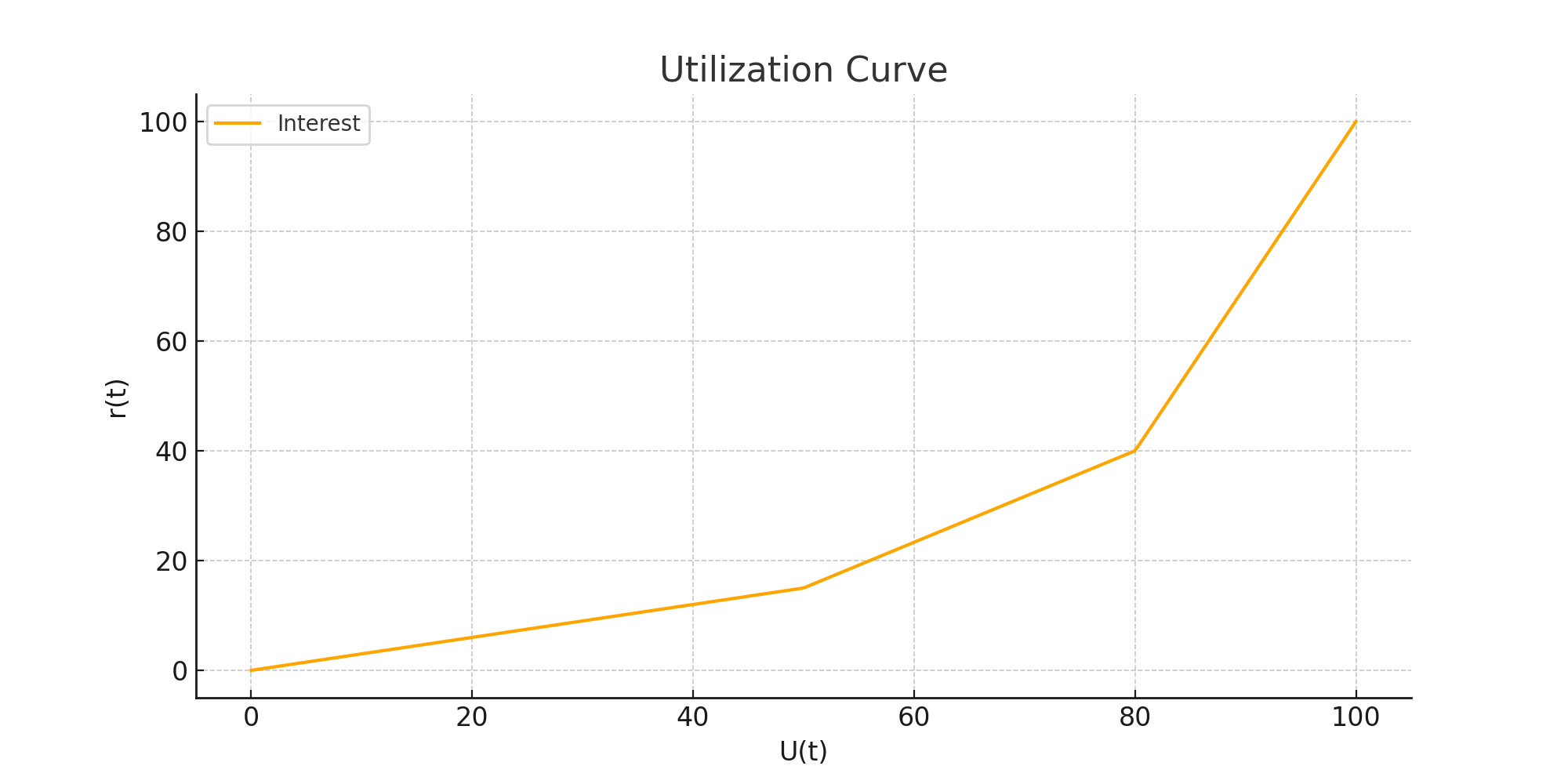
The more the liquidity in the lending/borrowing pool is utilized, the higher the interest rate.
### Two Tick Utilization Curve
The profitability of Lenders depends on the Utilization Rate *U* - the higher utilization, the higher the interest rate. All strategies share the same rate.
The interest rate is calculated the following:
$$
r(t) = \begin{cases}
r\_0+ \frac{U(t)}{U\_1} (r\_1-r\_0), & U(t) \leq U\_1 \
r\_0 + r\_1 + (U(t)-U\_1) \frac{r\_2}{U\_2-U\_1}, & U(t) \in (U\_1,U\_2].\
r\_0 + r\_1 + r\_2 + (U(t) - U\_2) \frac{r\_3}{1-U\_2}, & (U(t) > U\_2
\end{cases}
$$
The two-tick model introduces three states essentially:
* **0 - 50% Utilization:** cheap to borrow
* **50 - 80% Utilization:** high but acceptable rate for borrowing
* **80 - 100% Utilization:** very expensive to borrow
r_0
r_1
r_2
r_3
U_1
U_2
0
15
25
60
50
80
### Extra Rates
On top of the regular interest rate described above, the DAO can vote to charge an additional rate for every strategy individually. The additional fees are distributed among the [lenders](broken://pages/77FsdM18N8ThnnLw5bNG) (thus making APYs higher) and the [dLP Lockers](/the-protocol/dlp-locking-dynamic-liquidity-and-boost.md).